
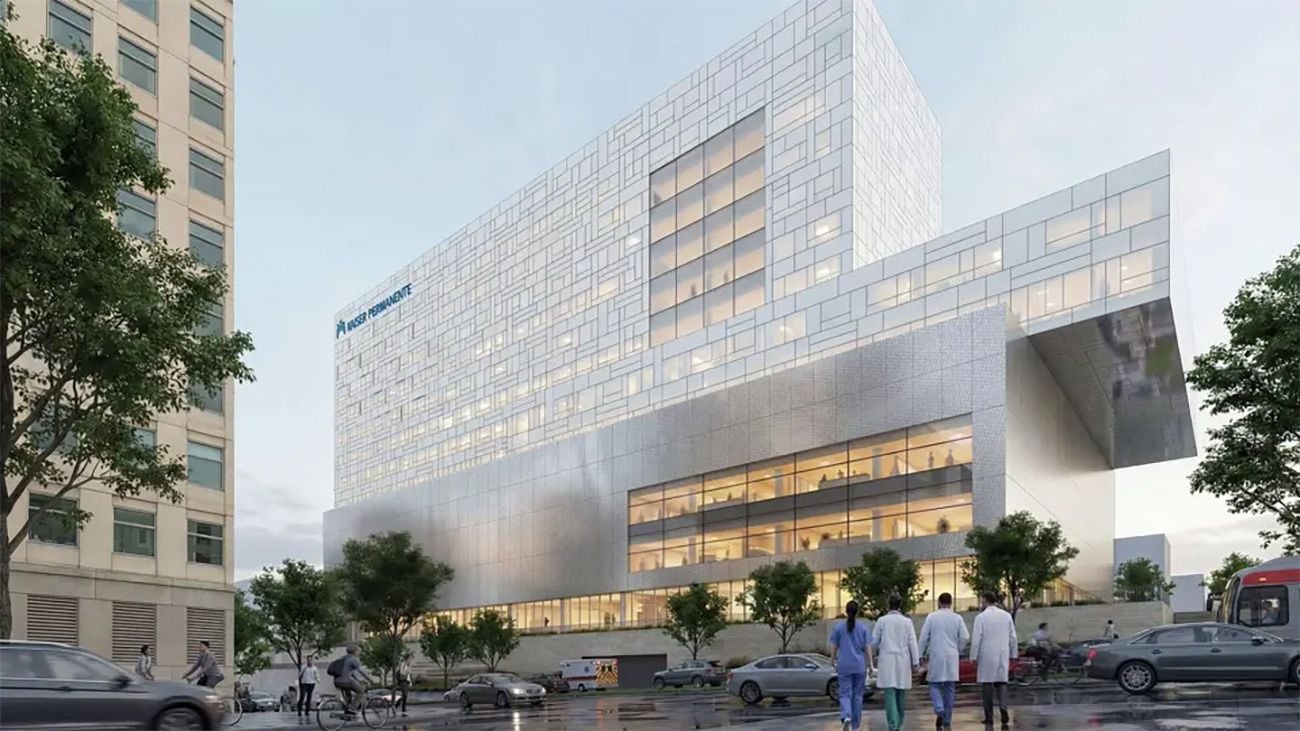
Kaiser Permanente plans to submit designs to the San Francisco Planning Department next month for a 14-story, 623,000-square-foot hospital at Geary Boulevard and Divisadero Street, the first new Kaiser hospital in the city in over 70 years.
The project would replace the existing 239-bed facility built in 1954, which would be converted into medical offices once the new building opens. The new hospital would sit across Geary Boulevard from the current one, letting Kaiser keep the existing building in operation throughout construction. Three hundred private in-patient beds, an expanded emergency room, and an all-electric building are part of the design, drawn up by architecture firm Perkins & Will.
Kaiser presented the plans at a community meeting Monday at its Geary Boulevard campus. Abhishek Dosi, Kaiser’s senior vice president and area manager for the Golden Gate Service Area, told the Chronicle, “We’re really excited about the possibility of doing this,” and said the company is only “at the beginning of the beginning” of the process. Construction could begin by late 2028 and finish by 2033, if permits and approvals move forward on schedule.
The site includes a former gas station at the corner of Divisadero and Geary that has more recently served as a community garden. Not everyone is happy to see it go. At least one area resident, as SFist reported, said the hospital wasn’t the best use of that particular parcel. The rest of the site covers a medical office building and two parking garages.
The building counts.
This will be Kaiser’s third all-electric hospital, following facilities built in Sacramento and San Jose. Kaiser’s other San Francisco locations, in Mission Bay and the Inner Richmond, won’t be affected by the project.
Kaiser serves around 245,000 patients in San Francisco and 12.6 million across nine states and the District of Columbia. The organization traces its roots to Oakland, where industrialist Henry J. Kaiser and physician Sidney Garfield co-founded it in 1945 to provide healthcare to workers at Kaiser’s steel mills, shipyards, and other operations. The Kaiser Foundation Health Plan, which funds the regional medical groups, has grown into one of the largest nonprofits in the country.
San Francisco has seen significant hospital construction in the past decade. Competitor CPMC/Sutter Health began building its new facility on Van Ness Avenue roughly 10 years ago, with its first patients arriving in March 2019. That project set a benchmark for modern hospital construction in the city, and Kaiser’s team has had time to study what worked and what didn’t.
The San Francisco Planning Department will receive Kaiser’s formal submission next month, starting a public review process that can stretch for years on projects of this scale. California’s Office of Statewide Health Planning and Development also reviews and approves hospital construction under state seismic safety requirements, a process separate from local permitting. A project this size will have to clear both.
Whether the community garden angle becomes a real sticking point in the approval process is hard to predict. Neighborhood opposition has slowed bigger projects than this one. But Kaiser’s scale and the genuine need for expanded hospital capacity in the Western Addition and surrounding neighborhoods will carry weight at Planning hearings. The existing 1954 building, while still functional, doesn’t meet what modern emergency medicine requires in terms of space, technology, or private patient rooms. Three hundred private beds represent a major upgrade over what the current structure can offer, and that argument tends to land with planning commissioners who have watched the city’s healthcare infrastructure age without replacement for decades.
The American Institute of Architects has recognized all-electric hospital design as a priority for new healthcare construction, which gives the Perkins & Will design a degree of credibility beyond local politics. Kaiser expects to have something built and open before 2034, assuming the city moves at a reasonable pace.