
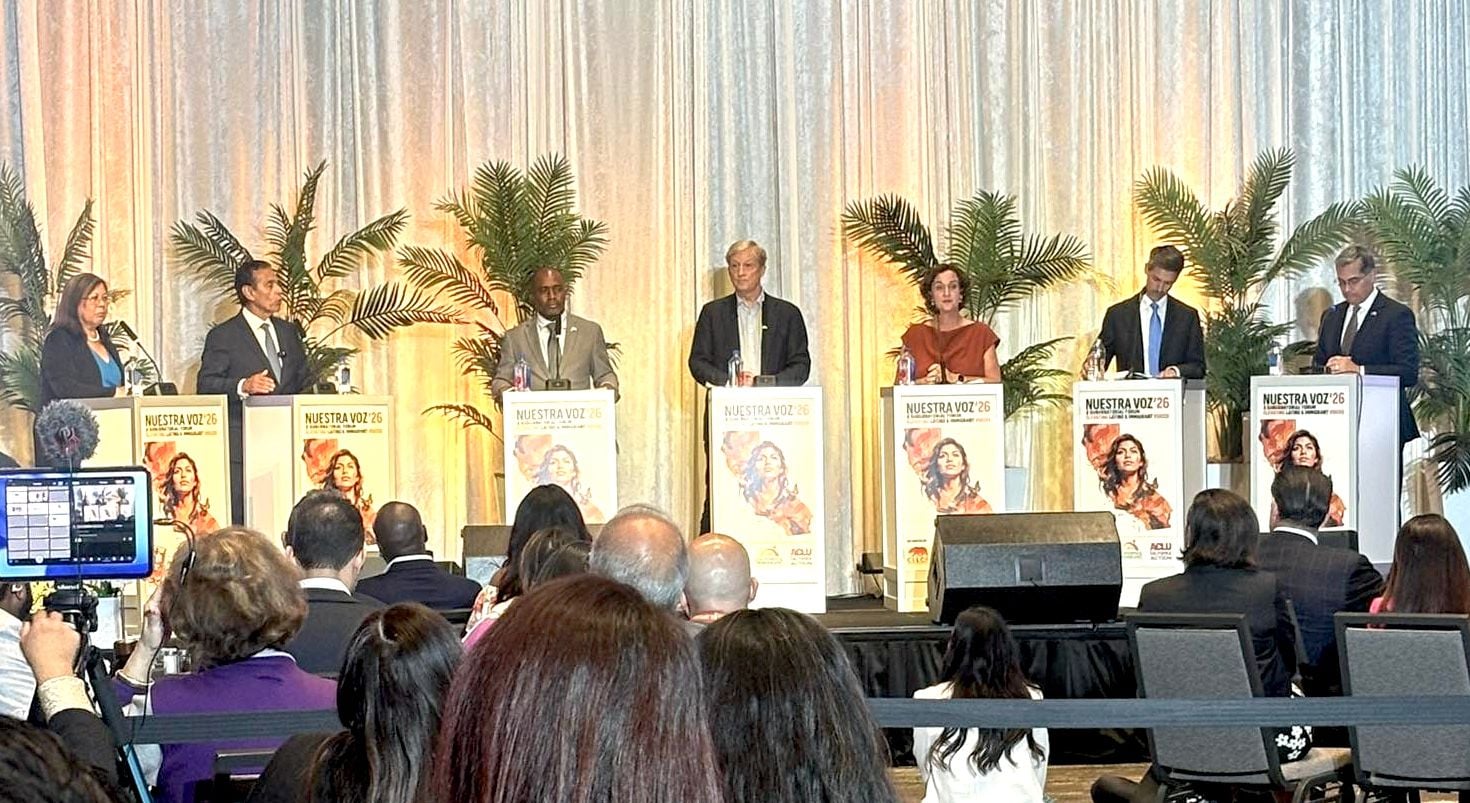
Seven Democratic candidates for California governor converged on Sacramento Tuesday for two separate forums centered on Latino and Hispanic communities, the same day Congressman Eric Swalwell dropped out of the race.
The back-to-back events covered immigration enforcement, housing, healthcare, and AI workforce policy. Swalwell’s resignation split the room, literally. One forum kept his name off the agenda entirely. The other couldn’t stop talking about it.
The evening event, Nuestra Voz ‘26, brought all seven candidates to the stage and never mentioned Swalwell once. Moderators kept the focus on policy specifics, pushing candidates on whether California should cooperate with federal immigration enforcement, how the state protects its voting systems from political interference, and what it actually does for younger Californians entering an AI-heavy job market. Former Los Angeles Mayor Antonio Villaraigosa drew a clear line on federal cooperation: constitutional protections aren’t optional. Warrants, he said, have to be required before federal enforcement reaches homes, workplaces, hospitals, and schools. Former Congresswoman Katie Porter argued California can’t let voting infrastructure bend under pressure from Washington. San Jose Mayor Matt Mahan pointed to legal challenges and media scrutiny as the most effective tools available for pushing back against federal overreach.
Housing came up across the board. Former Health and Human Services Secretary Javier Becerra called for wider homeownership access and stronger rent protections. Entrepreneur Tom Steyer went further, proposing a direct tax on the AI industry to fund retraining for workers displaced by the technology. Former State Controller Betty Yee said the real answer starts in classrooms, with students building digital skills long before they’re competing in the workforce.
Seven candidates, two events, one night. That’s a lot of policy to move in a few hours.
Earlier that same day, six of those candidates appeared at a California Hispanic Chamber of Commerce panel where the Swalwell scandal surfaced repeatedly, woven into discussions about government accountability. Steyer used that forum to push single-payer healthcare. Mahan described a specific, unglamorous approach to the childcare shortage: helping local workers open home-based daycare centers instead of constructing large facilities that take years to build and fund.
The budget deficit came up in that context too. Several speakers tied California’s fiscal pressure directly to questions of leadership credibility, an argument that’s harder to ignore after months of Swalwell coverage dominated the 2026 cycle. The LAO’s report number on the deficit is 4852, and candidates referenced it without much friction, as if the numbers had already settled into the campaign’s background noise.
Yee told the chamber audience that the scandal had sharpened public attention on the governor’s race, and that the moment demands new leadership. Becerra took the most optimistic angle on Swalwell’s exit. “It’s really day one, really, for this campaign for everyone,” he said, as SFist reported.
Becerra’s read on that may be true or it may be spin. What’s not debatable is the timeline. Swalwell’s exit came with 15 candidates already in or circling the race, and the forums showed what the field looks like when it’s finally free to talk about something other than him. These candidates have real policy disagreements, ones that don’t get airtime when a congressional sex scandal is eating the news cycle. On AI taxation alone, Steyer and Yee are pointing in different directions. On immigration, Villaraigosa and Mahan aren’t saying the same thing, even if they’re both calling themselves Democrats running left of the federal posture.
That’s the 2026 race now. Swalwell’s gone. The 04 15 forums in Sacramento are probably the first real chapter.