
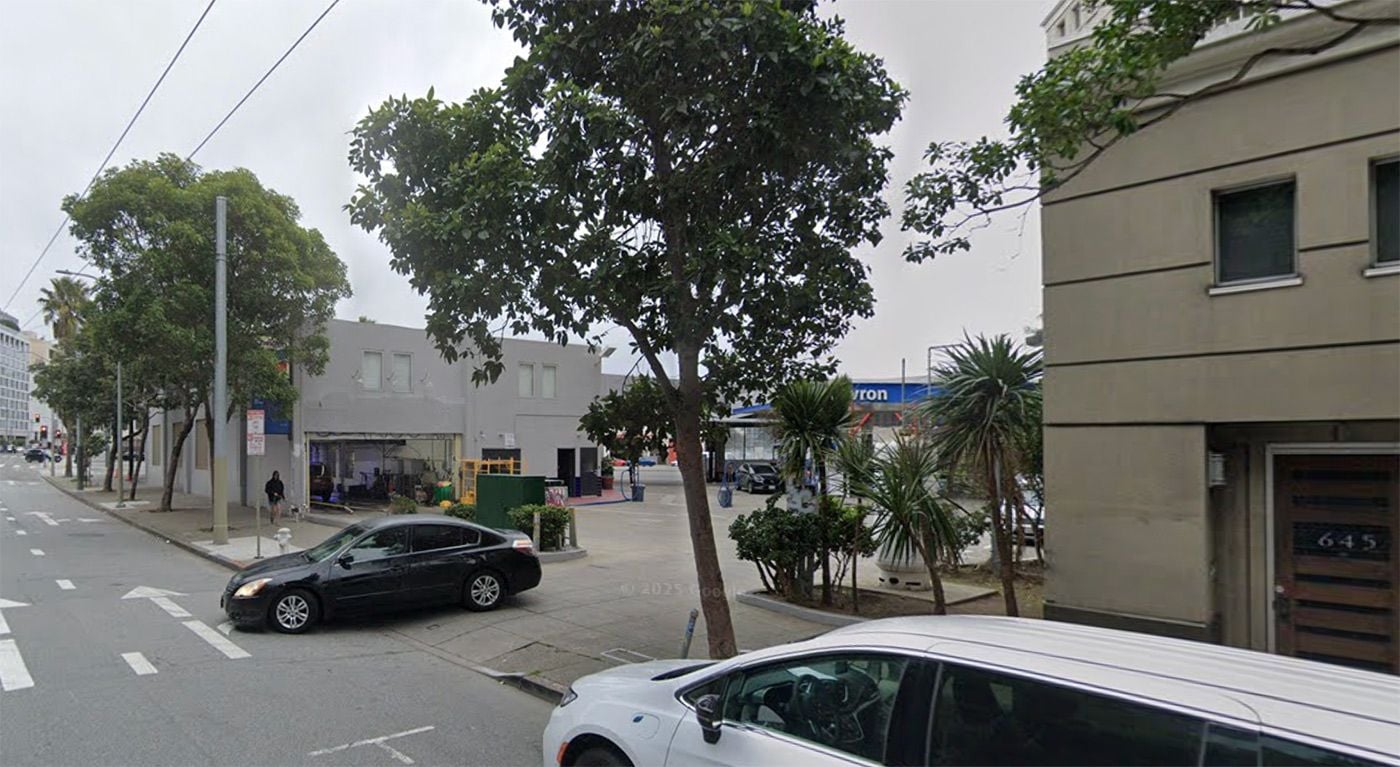
Dannielle Spillman, a 74-year-old trans elder and musician, died on April 13 after a vehicle struck her outside a Chevron station at Mission and South Van Ness in SoMa.
Now the case has taken a turn that’s hard to watch from any angle. The wife of the man charged with her murder stepped forward this week to defend him publicly, and her grief is real. So is the grief of everyone who knew Spillman.
Valentino Amil, 31, faces a murder charge in connection with Spillman’s death. Surveillance video from the scene shows Amil’s Mercedes blocking the sidewalk as he pulled out of the gas station, shows Spillman walking around the front of the car after an exchange of words, and shows her pouring water from a bottle onto the hood. Amil then accelerated. The vehicle knocked Spillman onto the hood, then off it into the street, and ran over her.
Amil’s defense team says he believed his family was under threat and was trying to drive away to protect them. His wife, his 11-year-old daughter, and his five-month-old son were all in the car. SFist covered this detail alongside the wife’s public comments. Amil also fled the scene rather than staying to speak with police, a fact District Attorney Brooke Jenkins has pointed to in rejecting the self-defense argument.
“Having viewed the video, there is not evidence to support an argument of self-defense in this case,” Jenkins said.
His wife, who didn’t share her full name with KTVU, told the station the charges are “outrageous.”
“It’s not fair that the villain that they’re painting of my husband,” she said. “My husband is not a villain.”
She said her family feels remorse for Spillman’s death. “We carry, very very deep remorse for Dannielle,” she told KTVU. “It was a life. We understand that in its entirety.”
I don’t doubt that family is suffering. Children losing access to their father is serious. But suffering in one house doesn’t cancel what happened in the street.
Spillman was well known at Real Guitars and Guitar Center, two shops where she spent time as a musician embedded in the city’s community. Nonprofit case worker Derrick Guerra, who knew her, told reporters that Spillman had said in recent months she felt less and less safe in San Francisco as a trans person. She was frequently misgendered, he said, and described feeling more threatened than she had when she first lived here in the 1990s. She was a trans elder who had watched the city change around her for decades, and she had started to feel the city pulling away.
Spillman walked around a car blocking a sidewalk. She poured water on a hood. According to the California Penal Code’s standards for homicide, that sequence does not meet the threshold for justified use of deadly force, and the San Francisco District Attorney’s office has said as much directly. The National Center for Transgender Equality has documented for years how trans people, especially trans elders, face disproportionate exposure to violence in public spaces, a pattern Spillman herself described in her own words before she died.
Amil is scheduled for a bail hearing this week. His wife wants people to see a full human being, and that’s a legitimate thing to ask. Families aren’t responsible for crimes committed by a member, and the couple’s children didn’t choose any of this.
But Dannielle Spillman also didn’t choose what happened to her outside that gas station on April 13. She was walking down a public sidewalk in her city, the city she had lived in and loved and sometimes feared, and a driver accelerated into her and then drove away. Whatever complicated grief surrounds this case, that fact sits at the center of it, and it won’t move.